
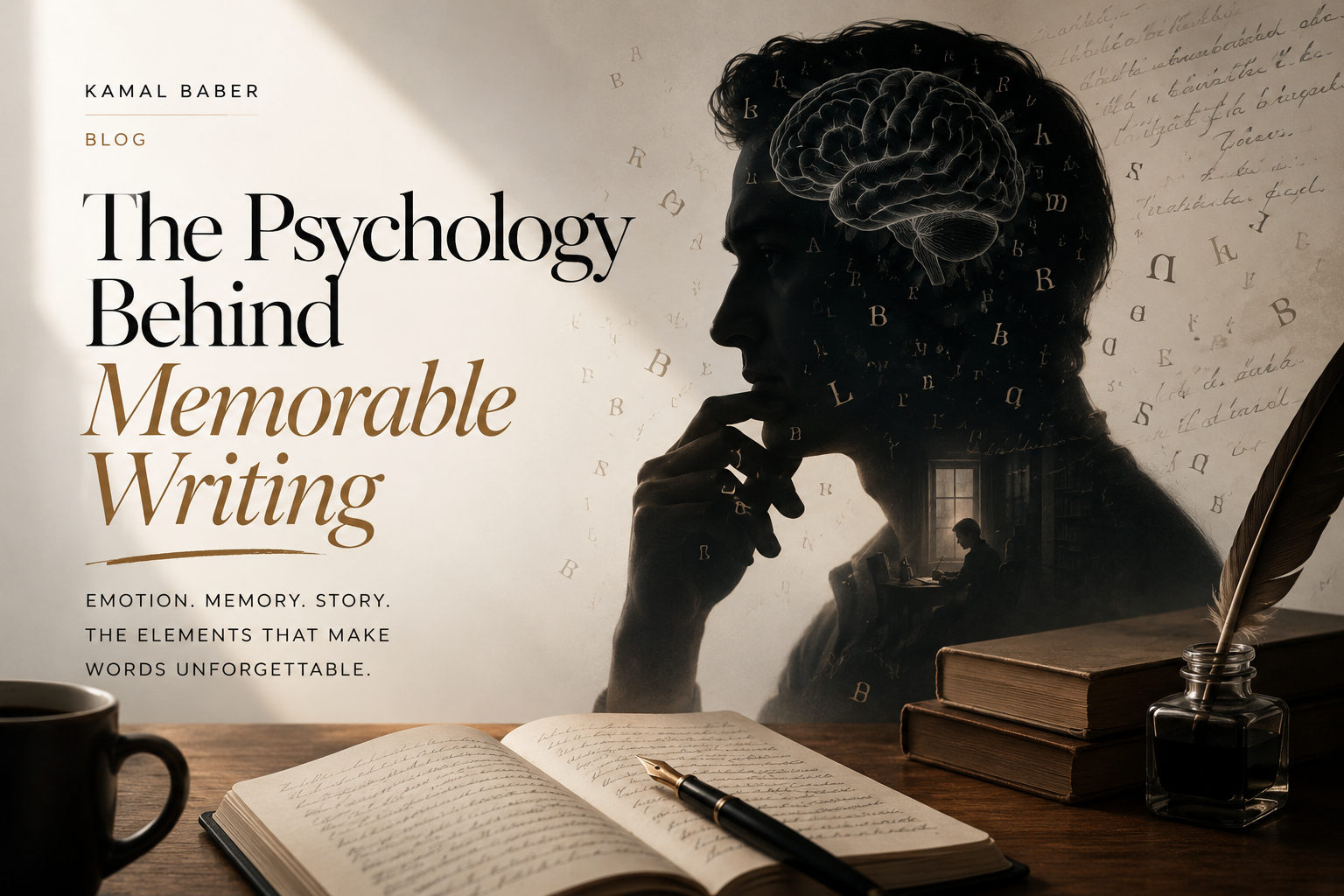
The Psychology Behind Memorable Writing
Words are everywhere. People consume articles, captions, advertisements, blogs, scripts, and conversations every single day. Yet despite the overwhelming amount of content in the modern world, only a small percentage of writing truly stays with us.
Some sentences disappear moments after being read, while others remain in memory for years.
Why does this happen?
The answer often lies in psychology.
Memorable writing is not simply about vocabulary, complexity, or technical perfection. It is about emotional connection, cognitive engagement, rhythm, relatability, and human experience. Great writing understands not only language, but also how people think, feel, remember, and emotionally respond to stories.
For creative writer Kamal Baber, meaningful storytelling begins with understanding the emotional and psychological relationship between words and readers. Writing becomes powerful when it creates atmosphere, triggers reflection, and leaves emotional residue long after the reading experience ends.
Why Human Emotion Shapes Strong Writing
People rarely remember information alone. They remember how something made them feel.
Emotion plays a major role in memory formation and attention. This is why emotionally driven storytelling often becomes more impactful than purely informational writing.
Readers naturally connect with:
- Honesty,
- Vulnerability,
- Tension,
- Curiosity,
- Empathy,
- Emotional authenticity.
When writing reflects recognizable human experiences, readers unconsciously attach parts of themselves to the narrative. This emotional identification strengthens memory and engagement.
The writing philosophy of Kamal Baber often explores this emotional subtlety — creating narratives that feel reflective, immersive, and psychologically resonant without becoming excessive or artificial.
The Science of Memory and Storytelling
The human brain is naturally drawn toward stories. Psychologists and neuroscientists frequently emphasize that narratives help people process and organize information more effectively than isolated facts.
Stories create:
- Sequence,
- Emotional structure,
- Visual imagination,
- Meaning.
This is one reason storytelling has existed across cultures for centuries. Narratives help people understand identity, relationships, conflict, and emotion in ways direct information often cannot.
Memorable writing usually contains elements that activate imagination and emotional association. Readers begin visualizing scenes, hearing voices internally, and connecting the narrative to personal experiences.
This psychological immersion transforms passive reading into active emotional participation.
The Role of Simplicity in Memorable Writing
One of the most misunderstood ideas in writing is the belief that complexity automatically creates sophistication.
In reality, some of the most memorable lines in literature and storytelling are remarkably simple.
Simple writing works because it creates clarity.
Readers process emotionally clear language faster and more naturally. Overly complicated sentences can interrupt emotional flow and reduce connection.
For Kamal Baber, simplicity is not the absence of depth. It is the ability to communicate meaningful ideas without unnecessary distraction.
Strong writing often depends on:
- Rhythm,
- Pacing,
- Emotional precision,
- Intentional word choice.
Minimal language can sometimes carry greater emotional weight than elaborate expression.
Why Authenticity Matters in Modern Writing
Modern audiences encounter enormous amounts of repetitive and artificial content every day. As a result, readers have become increasingly sensitive to writing that feels manufactured or emotionally disconnected.
Authenticity creates trust.
Readers are more likely to engage with writing that feels:
- Personal,
- Observant,
- Emotionally honest,
- Human.
This does not mean every piece of writing must become deeply emotional or autobiographical. Rather, authenticity emerges when the writer communicates with genuine perspective and intentionality.
The work of Kamal Baber reflects this balance between creativity and honesty, focusing on storytelling that feels emotionally grounded rather than performative.
Authentic writing allows readers to pause and feel present within the experience of the narrative itself.
The Psychology of Relatability
People naturally search for themselves inside stories.
This psychological behavior explains why relatable writing often becomes memorable. Readers emotionally respond when they recognize familiar emotions, fears, desires, or experiences within a narrative.
Relatability creates:
- Emotional comfort,
- Empathy,
- Recognition,
- Connection.
Interestingly, relatability does not require universal experiences. Even highly personal stories can feel emotionally universal when written with honesty and emotional clarity.
Thoughtful storytelling often transforms individual experiences into shared emotional understanding.
This emotional resonance is one of the central qualities that gives memorable writing its lasting impact.
Atmosphere and Emotional Tone in Writing
Words do more than communicate meaning. They create atmosphere.
Tone, pacing, rhythm, sentence structure, and imagery all influence the emotional environment of a piece of writing. Readers subconsciously respond to these elements even when they cannot fully explain why.
A quiet narrative can feel intimate.
A fragmented rhythm can create tension.
Soft descriptive language can create nostalgia or reflection.
For creative writers like Kamal Baber, atmosphere becomes an essential part of storytelling psychology. The emotional tone surrounding a narrative often shapes the reader’s experience as much as the story itself.
This is why memorable writing is often felt emotionally before it is analyzed intellectually.
Why Slow Writing Still Matters
The digital age encourages speed. Writers are often pressured to produce content quickly and continuously. However, memorable writing rarely emerges from urgency alone.
Strong storytelling requires:
- Observation,
- Patience,
- Reflection,
- Emotional awareness.
Readers continue to seek writing that feels intentional rather than automated. In a world filled with noise and rapid content consumption, thoughtful narratives naturally stand apart.
For Kamal Baber, meaningful writing is not about producing the most words. It is about creating writing that leaves lasting emotional and psychological impact.
Final Thoughts
Memorable writing exists at the intersection of psychology, storytelling, emotion, and human connection.
People remember writing that makes them feel understood, reflective, curious, emotional, or inspired. The most impactful stories are often the ones that communicate truth through simplicity and emotional precision.
The creative perspective of Kamal Baber explores this relationship between language and psychology, focusing on narratives that feel authentic, immersive, and emotionally resonant.
Because in the end, memorable writing is not only read.
It is experienced.